
Unlocking Hidden Grid Capacity: How Ecobee’s Grid Resiliency Service Delivered over 100 MW Across Three Markets this Summer
Traditional demand response (DR) programs have proven their value for grid reliability for years, but enrollment takes time. Building a large pool of participants requires sustained marketing, customer outreach, and equipment installation, which can take years to reach scale. Meanwhile, grid operators are increasingly in need of fast dispatchable resources during grid stress events where every megawatt counts.
What if utilities could access the Heating, Ventilation, and Air Conditioning (HVAC) demand flexibility of customers who were never enrolled in a DR program, and all it takes is owning a ecobee smart thermostat?
That’s the premise behind ecobee’s Grid Resiliency (GR) service, which Demand Side Analytics (DSA) evaluated across three major electricity markets during summer 2025. The results imply that auto-enrollment models can tap into substantial demand flexibility that traditional DR programs have been unable to reach.
The Study: Grid Resiliency Across CAISO, ERCOT, and SPP
Ecobee’s Grid Resiliency service, which was deployed through the California Independent System Operator (CAISO) through the California Energy Commission’s Demand Side Grid Support (DSGS) program, the Electric Reliability Council of Texas (ERCOT) Emergency Response Service (ERS) program, and a direct utility demonstration with Evergy in Kansas and Missouri in the Southwest Power Pool (SPP) Market.
| Figure 1: Grid Resiliency Deployment by Market |
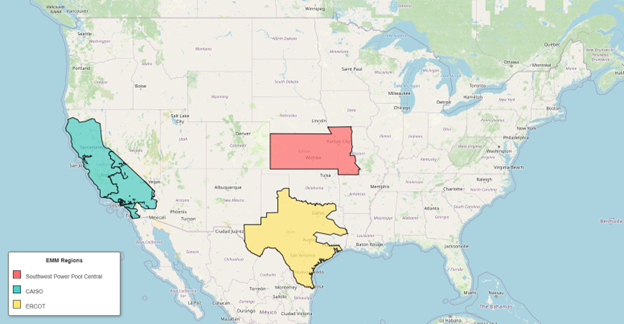
The GR service operates through ecobee’s eco+ platform, automatically enrolling customers who have enabled the Community Energy Savings feature but are not already participating in a utility DR program. When grid conditions become critical, the service temporarily adjusts thermostat setpoints by anywhere from 1 to 4 degrees for up to four hours. Customers get advance notifications and full opt-out control.
Across 11 events during summer 2025, the service called on over 143,000 unique devices and demonstrated 108 MW of load shift capability. The study sought to answer several key questions.
- How does this auto-enrollment approach perform compared to traditional programs?
- Is the response consistent across different markets and weather conditions?
- What is the nationwide potential for this resource?
How We Measured Performance
DSA applied market-specific evaluation protocols to measure the load impacts of GR. For CAISO (California’s Market), we followed the DSGS Option 4 protocol, creating four-day weather-matched baselines and applying day-of adjustments to account for any pre-event conditions. For ERCOT we developed regression models for each of the 8 climate zones using temperature, time-of-day, and historical non-event consumption patterns. For the Evergy demonstration in SPP, we implemented a “high 2-of-10” baseline methodology consistent with regional settlement practices.
In each case, we converted thermostat runtime data to demand estimates using region-specific connected load assumptions and calculated impacts as the difference between the baselines and actual consumption during the event windows.
Results: Consistent Performance
The GR service delivered load reductions across all three markets. ERCOT events achieved an average per-device impact of 1.05 kW across eight events, with peak reductions reaching 1.56 kW per device. The Evergy demonstration in SPP delivered 1.00 kW per device on average. CAISO’s two events operated under milder temperatures and longer four-hour dispatch windows, with weather-normalized per-device capability exceeding 0.5 kW. In aggregate, ERCOT events produced up to 78 MW of demand reduction per event, SPP delivered over 16 MW, and CAISO contributed 14 MW across its two events.
| Figure 2: Example Grid Resiliency Event (ERCOT) |
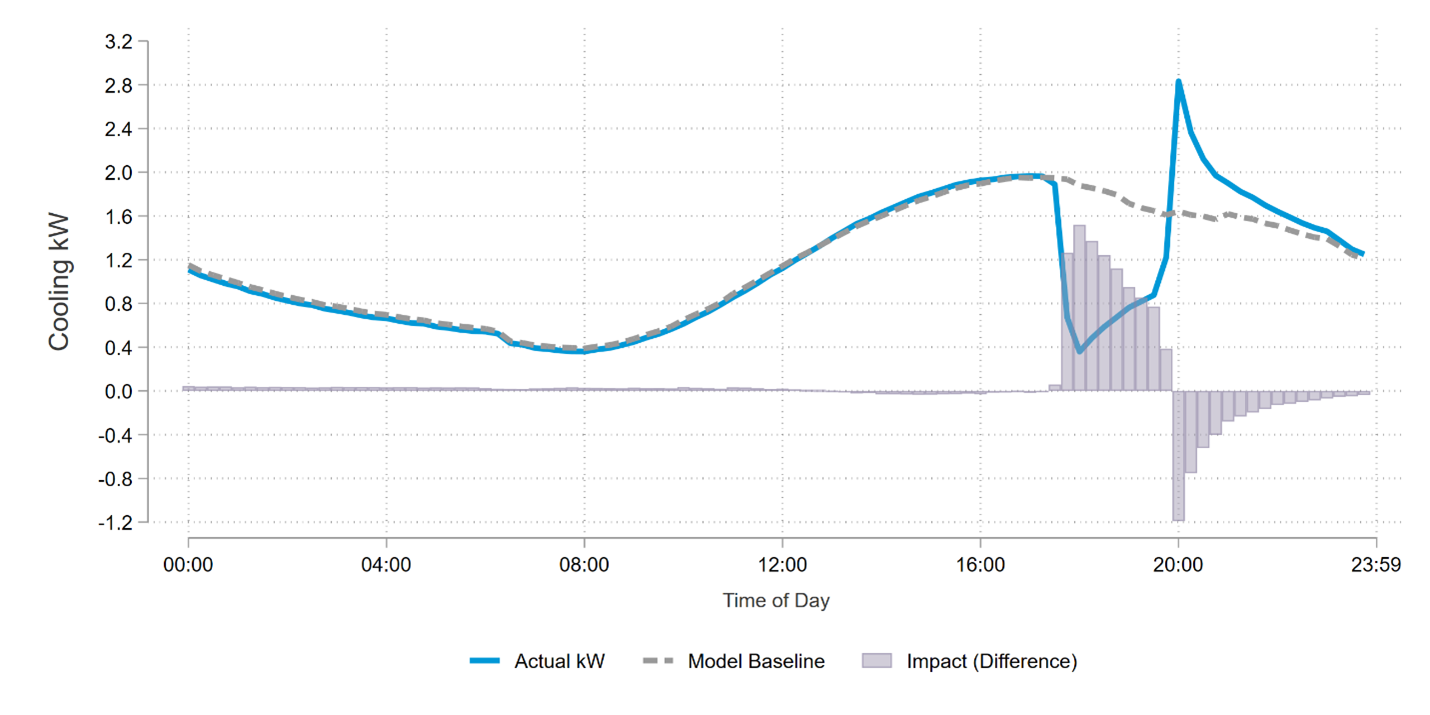 |
A key finding is that GR performance scales with temperature (which is often high in the case of grid stress). The July 30 ERCOT event at 94.4 degrees Fahrenheit achieved the highest per-device impact at 1.26 kW, while the September 25 ERCOT event at 79.6 degrees Fahrenheit produced the lowest at 0.58 kW. This alignment between resource capability and grid needs is precisely what operators look for in a critical capability resource. It delivers when conditions are highly stressed.
Figure 3: Average Event Participation across Markets
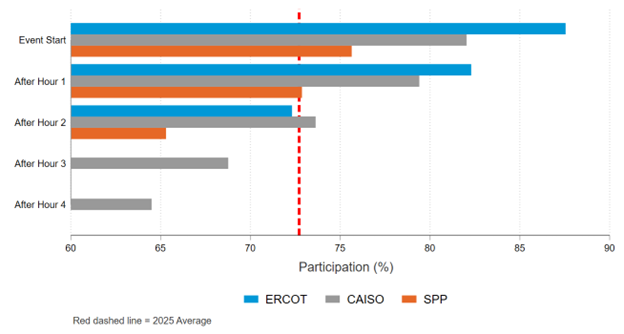
The most striking finding came from the participation data. Across all markets, events began with 75-88% enrolled devices participating, and two thirds remained active through event completion (a event attrition pattern typical of opt-in thermostat programs). The key difference being the GR service reaches devices that would not be participating in a utility program in the first place.
Why Auto-Enrollment Changes the Equation
Traditional DR programs require customers to take actions like responding to marketing, completing enrollment, and installing equipment. Even well-designed programs that aim to eliminate many barriers of entries can sometimes struggle in enrolling a large percentage of eligible customers. The remaining potential of unenrolled but willing customers remains untapped.
The GR service flips this traditional demand response enrollment model by leveraging devices already in customer homes and enabling participation by default. It reaches most eligible thermostats in each utility service territory and customers receive transparent notification of events and retain full control meaning they can opt out of an event at any time via their thermostat or ecobee mobile app.
This matters for several reasons. First, it expands the pool of capacity without additional marketing or incentive costs for utilities. Second, it provides a resource that can be deployed rapidly during emergencies without the lead time required to recruit and enroll new participants. Third, it captures value from customers who support grid reliability in principle but haven’t taken the steps to formally enroll in a program.
Looking Ahead
As part of this study, ecobee provided device count estimates of customers with the Community Energy Savings enabled. Based on our summer 2025 load impacts, we estimate that the nationwide capability of the GR service to be at about 2500 MW. This estimate assumes an average capability of roughly 0.8 kW per thermostat with regional adjustments and accounts for devices not currently enrolled in utility DR.
As grid stress events become more frequent, and electrification adds new loads, the value of fast, dispatchable demand-side resources will only grow. Auto-enrollment models like the Grid Resiliency service offer a solution to unlock untapped capacity. Creating a pathway for auto-enrollment could meaningfully expand demand response potential toolkit in many different markets.
DSA evaluated the ecobee Grid Resiliency service across CAISO, ERCOT, and SPP markets during summer 2025. For more information about this study or similar demand response evaluations, you can read the official report here or contact us for more information.