
Heat Pump Performance in Maine Homes
Heat pumps are increasingly seen as a cornerstone of building electrification. When designed and used effectively, they can dramatically reduce fossil fuel consumption, lower emissions, and improve household comfort and economics, even in cold climates like Maine. But as adoption accelerates, utilities and policymakers face a critical question: are customers using heat pumps as their primary source of heat, and how do these systems perform in real-world conditions?
The answer matters. If heat pumps sit idle during cold winters or are used as supplemental heating equipment, the expected fuel savings and emissions reductions are not realized. If, however, they reliably displace fossil fuels when it matters most, they can become a powerful and predictable resource for decarbonization and grid planning.
Efficiency Maine is one of the most aggressive promoters of cold climate air source heat pumps in the country. In fall 2023, following a series of heat pump utilization studies commissioned by Efficiency Maine and performed by Demand Side Analytics (DSA) and Ridgeline Energy Analytics (Ridgeline), Efficiency Maine redesigned its residential heat pump program strategy for individual heat pump incentives to a “whole home” design. After two winters using the new approach, Efficiency Maine again contracted DSA and Ridgeline in 2025 to evaluate the performance of its Whole-Home Heat Pump (WHHP) Rebate Program. The evaluation combined three complementary perspectives:
- Advanced Metering Infrastructure (AMI) data from about 1,000 homes were used to measure how electricity use changes after heat pump installation. The full report is available online here.
- End-use metering data from 78 homes were used to isolate heat pump electricity consumption from other household loads. The full report is available online here.
- A survey of 1286 WHHP participants to understand customer behavior, comfort, confidence, and decision-making. The full report is available online here.
The goal was straightforward but critical: determine whether Efficiency Maine’s shift from its legacy program design allowing rebates for supplemental heat pumps to its new requirement that heat pumps be designed and sized to heat the whole home improved the system economics, and changed how Mainers heat their homes, and how that change shows up on the electric grid.
Evaluation Approach
The evaluation followed a structured, evidence-based framework to connect customer experience with system-level impacts.
Step 1: Measure Real-World Load Impacts
AMI data were used to compare electricity usage before and after heat pump installation, with a focus on winter months and peak demand periods. This made it possible to quantify how whole-home heat pumps affect system load under real operating conditions.
Step 2: Isolate Heat Pump Behavior
A sample of households was selected for the installation of metering equipment to investigate suspected underutilization of heat pumps. Metering data were used to separate heat pump electricity consumption from other household loads. This step was essential for understanding when heat pumps were running, how intensively they were used, their efficiency, and whether they were meaningfully contributing to winter heating demand.
Step 3: Ask Customers Directly
A WHHP participant survey provided insights that AMI data alone cannot capture. Participants were asked about their heating behavior, comfort levels, confidence in their systems, and interactions with installers.
Step 4: Compare Against a Legacy Supplemental Program
Finally, results were benchmarked against findings from Maine’s earlier legacy supplemental heat pump rebate program, which did not require heat pump systems to be the primary heating source. (The new program design requires that the heat pump system meet at least 80% of a home’s peak heating load). This comparison made it possible to isolate the impact of the program design change.
Together, these steps linked what customers said with what their meters showed, creating a more complete picture of how whole-home heat pumps perform in practice.
Key Finding #1: Heat pump electricity use increased in expected ways.
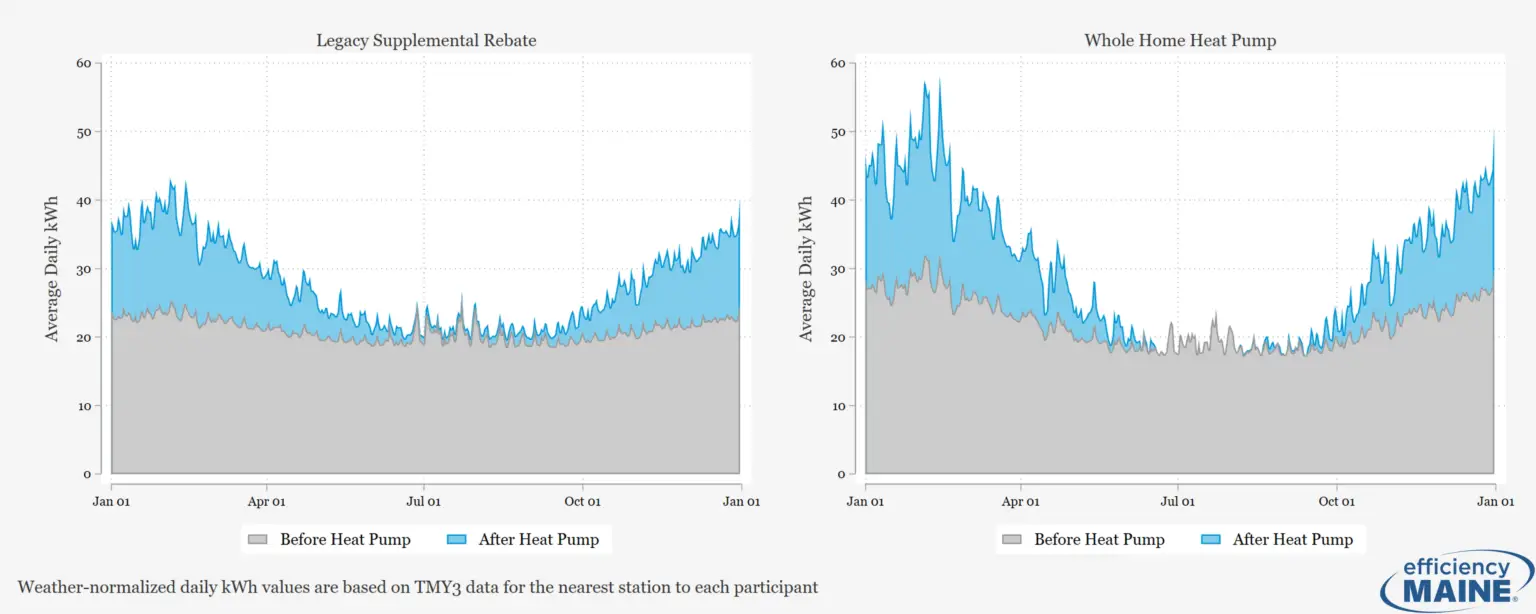
On average, homes participating in Efficiency Maine’s WHHP program use 4,904 kWh annually for heating with heat pumps, delivering approximately 52 MMBtu of heat. Compared to the earlier generations of Efficiency Maine’s heat pump rebate program, which had smaller incentive amounts and did not establish any minimum requirements for design load capacity, total kWh consumption for heating with heat pumps nearly doubles in the new WHHP program (Figure 1).
Under the new WHHP program, electricity consumed per kBTU of rated heat pump capacity rises from approximately 109 kWh/kBtu_Rated@47 to 143 kWh/kBtu_Rated@47 compared to the legacy program design. Alongside improved COPs, the higher electrical usage by the heat pump systems will improve electric system utilization and place downward pressure on electricity distribution rates. The increased winter electric consumption is also a direct proxy for reduced fossil fuel usage, which is largely fuel oil given Maine’s limited natural gas network.
For homes that were included in the metering sample, we compared our AMI-based estimate of annual heat pump heating kWh with the annualized meter-based estimate. We found strong alignment between the two estimates. The average AMI-based estimate of annual heat pump heating kWh was 96% of the average meter-based estimate.
Figure 1: Heating Season Average Household Daily kWh by Day of Year and Period
Key finding #2: Whole-home program design drove higher utilization and greater fossil fuel displacement.
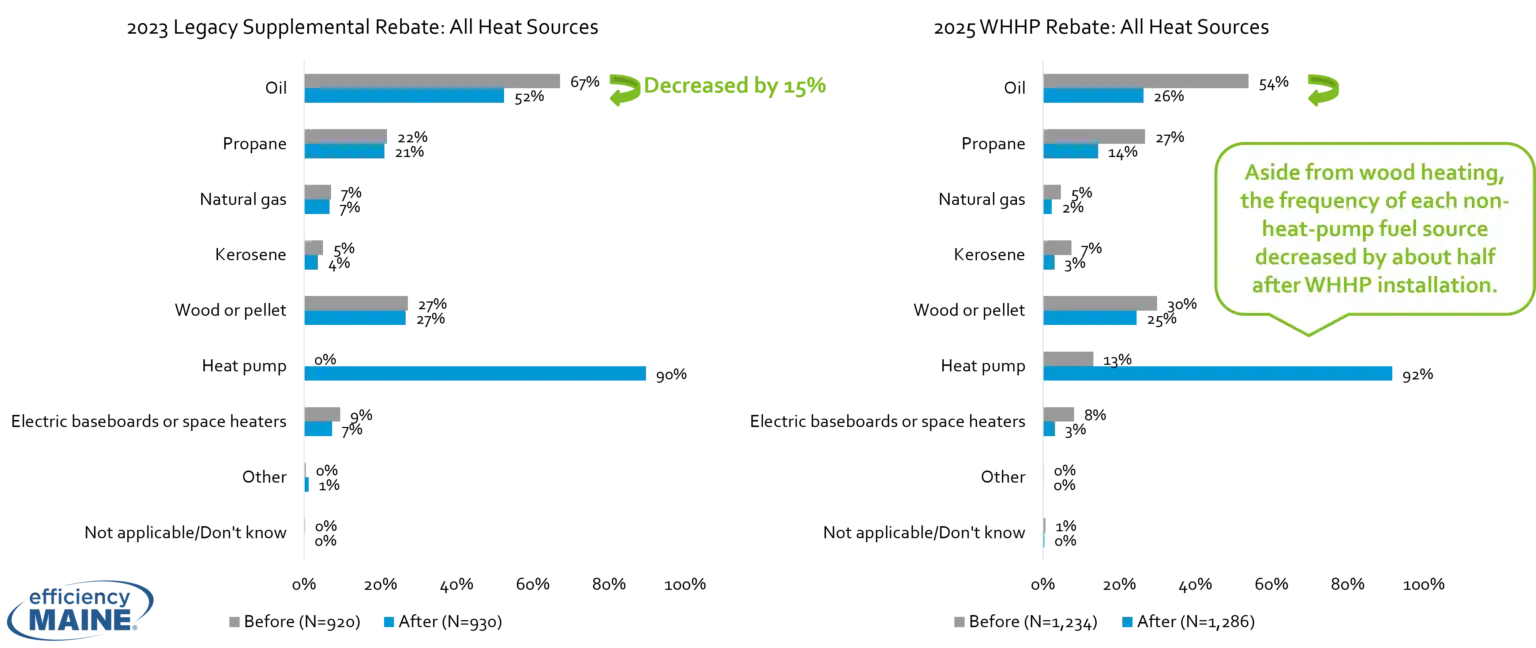
Both metered data and survey responses show that WHHP program participants rely on heat pumps far more frequently than participants in the legacy supplemental program on typical winter days and during very cold conditions. Reported use of oil, propane, and other fossil fuels declined sharply after installation.
AMI and metering results indicate that heat pumps in the WHHP program provided over 70% of total heating needs, with wood heat accounting for roughly 10% and fossil fuels making up the remaining 19%.
By requiring heat pump systems to serve as a home’s primary heating source (meeting at least 80% of the home’s peak heating load), the WHHP program encouraged installations sized to meet real heating needs. As a result, systems operated closer to their full capacity instead of sitting idle, leading to significantly greater displacement of oil, propane, natural gas, wood, and kerosene. For households previously reliant on fossil fuels, this translated into substantial cost savings and emissions reductions.
Figure 2: All heating sources in 2023 Legacy Supplemental Rebate and 2025 WHHP Rebate
Key finding #3: Better system design leads to improved comfort and higher utilization.
Survey results show that WHHP program participants experienced broader heat distribution, higher satisfaction, and a greater likelihood of recommending the program. Homes where installed heat pump capacity met or exceeded the home’s design heating load were significantly more likely to rely on heat pumps as their primary heating source.
This reinforces a key lesson: comfort and performance are inseparable. Systems that keep homes warm throughout the winter are the systems customers use, and those are the systems that deliver the largest grid and emissions benefits.
Efficiency Maine’s Whole-Home Heat Pump Rebate Program demonstrates that electrification can deliver real, measurable benefits when programs are designed with performance in mind. By pairing AMI analytics, end-use metering, and survey responses, this evaluation shows not just what was installed, but how it is used, when it matters, and why it works.